12 Fun Money-Saving Challenges to Try This Year

Savings challenges turn an abstract goal like “save more money” into a concrete daily or weekly action. The right challenge can help a saver stash away $365 to over $5,000 in a single year, depending on the structure and commitment level chosen. This guide breaks down twelve tested challenges, ranks them by payoff and effort, and shows how to pick one that actually fits a real budget.
Why Money-Saving Challenges Actually Work
Challenges succeed because they replace willpower with structure, turning saving into a game with visible progress instead of an open-ended sacrifice. A vague goal like “spend less” gives the brain nothing to grab onto. A rule like “roll the dice, transfer that amount” removes the daily decision entirely.
Behavioral finance research consistently points to the same pattern: people stick with systems that have clear triggers and visible feedback loops. A savings tracker taped to the fridge or a jar filling with coins gives that feedback in a way a bank balance buried in an app never does.
The trade-off is that some challenges are better suited to steady paychecks, while others work better for people with irregular income who need more flexibility week to week.
The 52-Week Challenge and Its Three Variations
The 52-week challenge grows a deposit by $1 every week for a year, finishing at $1,378, and three variations adjust the pacing to fit different budgets. It remains the most recognized savings challenge because the structure scales naturally with a calendar year.
Classic 52-Week Challenge
Save $1 in week one, $2 in week two, and continue increasing by $1 each week through week 52. The early months stay light on the wallet, then costs climb fast in November and December, right when holiday spending also peaks.
Savers who want to avoid that year-end squeeze often flip the order so the expensive weeks land early, while spare holiday cash is still on hand.
Reverse 52-Week Challenge
Start at $52 in week one and decrease by $1 each week down to $1 in week 52. The total saved matches the classic version exactly, but the heaviest deposits happen right after New Year’s, when leftover gift money and holiday bonuses are still available.
Biweekly 26-Week Challenge
This version fits a biweekly paycheck schedule. Deposit $4 in week one, $8 in week two, and add $4 every two weeks until reaching $106 in week 26. Total savings land at $1,404, slightly ahead of the standard 52-week plan for one extra week of deposits.
The 100-Envelope Challenge Broken Down
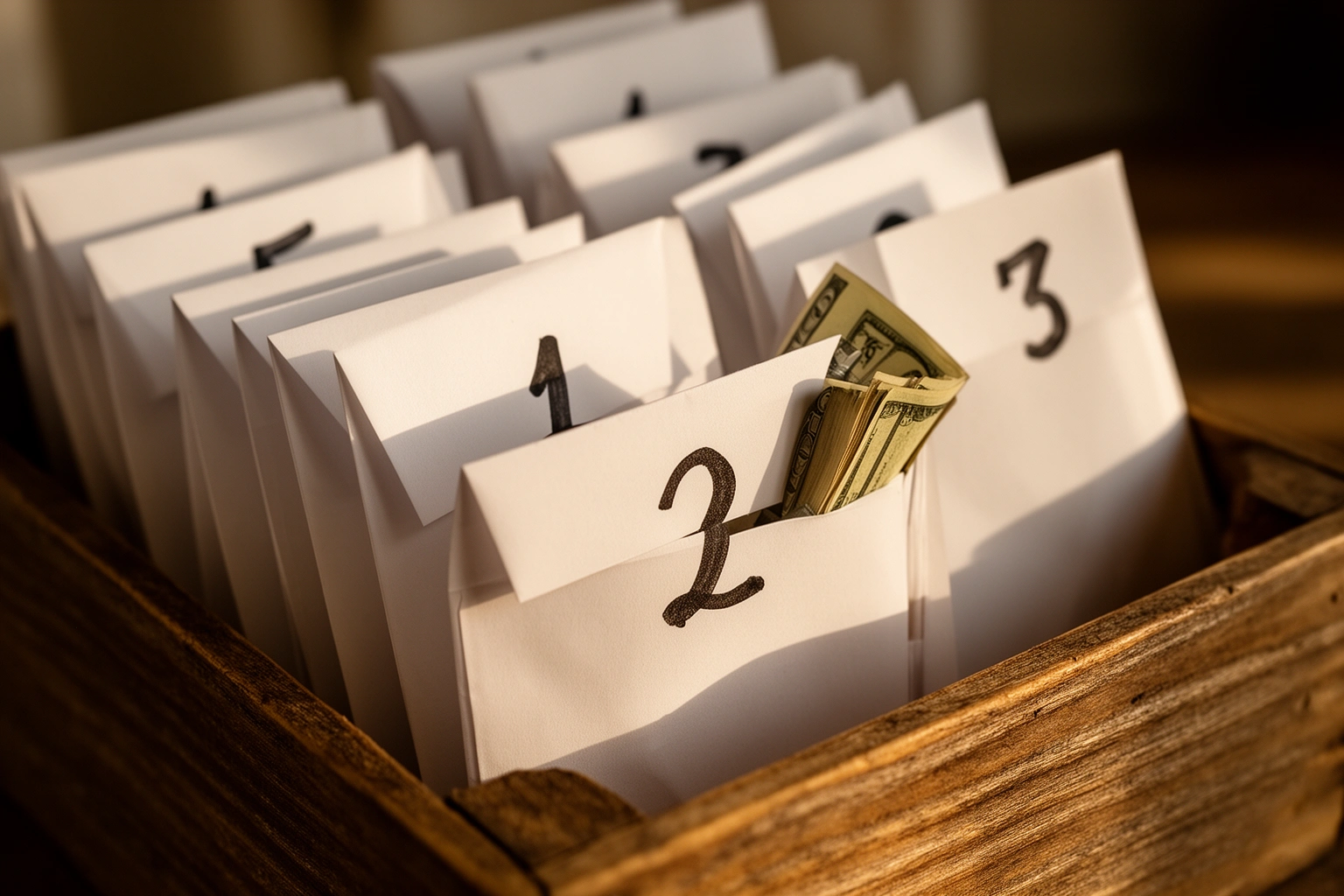
The 100-envelope challenge saves up to $5,050 in 100 days by filling numbered envelopes with matching cash amounts, making it the fastest high-payoff option on this list. Label 100 envelopes from 1 to 100, place them in a box or binder, and pick one at random each day.
Whatever number appears on the envelope becomes the deposit for that day. Envelope 3 gets $3, envelope 87 gets $87. Picking randomly instead of in order spreads the tough days across the full 100, so a saver isn’t stuck facing ten $90-plus days in a row near the end.
Anyone without easy access to cash daily can adapt this to a digital version by printing the dollar amounts on index cards and transferring the matching sum electronically instead. That removes the risk of keeping large amounts of cash sitting at home.
Low-Effort Daily Challenges
Daily micro-challenges like the penny challenge, round-up challenge, and dice challenge require almost no planning and work well for beginners who have never completed a savings goal before. Each one automates a tiny decision so saving happens without active tracking.
Penny Challenge
Save one cent on day one, two cents on day two, and keep increasing by a penny daily through day 365. By December, the deposits reach $3.65 a day, and the total for the year lands at $667.95. The gentle ramp makes this a common pick for teaching kids or teens the basics of consistent saving.
Round-Up Challenge
Every purchase gets rounded up to the nearest dollar, and the difference moves straight into savings. A $23.50 grocery run sends $0.50 into the account. Several banking apps now automate this transfer, which removes the need for manual tracking entirely and turns everyday spending into passive saving.
Dice Challenge
Roll a single die each morning and transfer that dollar amount into savings. Rolling every day for a year lands anywhere between $365 and $2,190, depending on the luck of the roll. Rolling two dice instead of one roughly doubles the potential total for anyone chasing a bigger number.
Challenges Built Around Existing Habits
Habit-based challenges like no-spend periods, subscription audits, and receipt tracking convert money already being wasted into savings without requiring new deposits from scratch. These work especially well for people who feel like they’re already stretched thin financially.
No-Spend Challenge
Pick a set window, a day, a weekend, or a full month, and avoid all spending outside essential food, housing, and transportation costs. Shorter windows like a single no-spend weekend help beginners avoid burnout before attempting a longer stretch. Every dollar not spent during that window gets transferred to savings immediately.
Subscription Cancellation Challenge
Pull up a bank or credit card statement and flag every recurring charge, streaming services, apps, unused gym memberships. Canceling the ones that go unused typically frees up $133 to $200 a month, which can be redirected straight into a savings account through an automatic transfer.
Receipt Savings Challenge
Every time a grocery receipt shows an in-store discount, that exact dollar amount gets moved into savings, not just left as a lower total on the bill. Someone who saves $5 on a $100 grocery run transfers that $5 separately. Tracked consistently over a year, this method alone can add up to roughly $2,000.
Budget-conscious readers who enjoy giving their savings routine a visual, motivating structure often apply the same principle to their approach to seasonal color palettes, using a simple visual system to stay consistent whether the goal is a fuller closet or a fuller savings account.

Comparison Table: Which Challenge Saves the Most, Fastest
The 100-envelope challenge delivers the highest total in the shortest window, while the penny challenge asks for the least commitment and the smallest payoff. Matching effort level to savings goal matters more than picking the challenge with the biggest headline number.
| Challenge | Duration | Total Saved | Effort Level |
|---|---|---|---|
| 100-Envelope | 100 days | Up to $5,050 | High |
| Biweekly 26-Week | 26 weeks | $1,404 | Medium |
| Classic / Reverse 52-Week | 52 weeks | $1,378 | Medium |
| Receipt Savings | 1 year | ~$2,000 | Low |
| Subscription Cancellation | Ongoing | $1,600-$2,400/yr | Low |
| Dice Challenge (2 dice) | 1 year | Up to $4,380 | Low |
| Round-Up Challenge | Ongoing | Varies (passive) | Very Low |
| Penny Challenge | 365 days | $667.95 | Very Low |
That is the maximum payoff of the 100-envelope challenge, the fastest large-sum result of any challenge on this list.
How to Actually Stick With a Challenge
Automating transfers, tracking progress visually, and building a make-up rule for missed weeks are the three habits that separate people who finish a savings challenge from those who quit by February. The challenge structure matters less than the follow-through system around it.
Set up an automatic transfer the morning after payday rather than relying on memory to move money manually. A second account with no debit card and a slower transfer time also adds enough friction to stop impulse withdrawals.
Pin a printable tracker somewhere visible, a fridge, a desk, a notes app, and color in a box every time a deposit clears. Readers who enjoy tracking small consistent wins already understand this instinct from following AestheticPFPs, where building any personal habit, financial or aesthetic, comes down to small repeatable actions that compound over time.
Build a make-up rule before starting. Decide in advance whether a missed week gets doubled the following week or pulled from a small buffer fund, so one skipped deposit doesn’t turn into an abandoned challenge.
Frequently Asked Questions
What is the fastest money-saving challenge?
The 100-envelope challenge is the fastest high-payoff option, saving up to $5,050 in just 100 days by filling numbered envelopes with matching cash amounts.
Which money-saving challenge saves the most money overall?
The 100-envelope challenge tops the list at roughly $5,050, followed by the biweekly 26-week challenge at $1,404 and the standard 52-week challenge at $1,378.
Can I combine two savings challenges at once?
Yes, many savers pair a passive challenge like the round-up challenge with an active one like the 52-week challenge since one requires no effort and the other builds a structured habit.
What happens if I miss a week during a savings challenge?
Build a make-up rule before starting, either doubling the deposit the following week or pulling the missed amount from a small buffer fund, so one skipped week does not end the challenge.
Are savings challenges better than automatic transfers?
Savings challenges work best for building a new habit through visible progress, while automatic transfers work best for maintaining a habit once it already exists, so many savers use both.
What is the easiest savings challenge for beginners?
The penny challenge is the easiest starting point since deposits begin at one cent and increase gradually, making it a common first challenge for beginners and kids.
How much can the round-up challenge save in a year?
The round-up challenge has no fixed total since it depends on spending habits, but rounding every card purchase up to the nearest dollar typically adds up to $10 to $30 a month passively.